
27 March 2026
Enzo Ferrari and the origins of a motoring legend
10 minutes
Enzo Ferrari’s life and legacy could well be a metaphor for a racing car. A slow start that quickly fires up creating momentum, leaving all others trailing in the dust. Born in Modena, Italy, in the dying embers of the 19th century, Enzo grew up with a constant hammering noise ringing in his ears; the striking of metal in his father’s workshop, where men toiled over making parts for the rail industry. Long before he started making automotive history, he learned the art of craftsmanship the old way: watching artisans shaping instruments painstakingly by hand. And it was these early observations that gave him a mechanic’s respect for function and an artist’s eye for form – although Enzo was never driven to follow in his father’s footsteps.
Ambition and obsession collided early when age ten, Enzo stood at the side of the road, witnessing Felice Nazzaro drive to victory at the 1908 Circuito di Bologna. The sound of the cars, the spectacle of a crowd transfixed, and the unmistakable smell of hot engine oil was the combination that set him on the road to automotive legend – but there were some tricky chicanes to traverse en route. The First World War claimed the lives of both his father and brother. The subsequent collapse of the family business was the catalyst for him to look for work in Italy’s burgeoning motor manufacturing sector. This formative chapter in Ferrari’s life was that slow-burn opener, as he found a job as a test driver. But it was here that he uncovered his innate ability to tune into a car’s individual “voice” – understanding subtle differences in vibrations and revs that can make the difference between a great ride and legendary drive.
In the driving seat
In 1919, just a year after the conclusion of The Great War, Enzo shifted gears from test driver to racer, piloting the decent-enough Costruzioni Meccaniche Nazionali (CMN) in the Parma–Poggio di Berceto hill climb. Finishing fourth in his class, in 1920, this was the access route to racing for Alfa Romeo, where he quickly became revered for his fearless driving in tandem with an instinct for engineering insight.
Inevitably for the time, when motor racing was still in its uncertain infancy, there were lives lost in this unpredictable sport. The death of Ugo Sivocci in 1923 while test driving an Alfa Romeo, and then Antonio Ascari in 1925 in the French Grand Prix also in an Alfa Romeo, removed what was left of Ferrari’s appetite to race competitively. And in its place – space to fulfil a bigger dream; creating not just a racing car, but a motor built for the future that would blaze a trail around every road and race circuit.
And so began Scuderia Ferrari, founded in 1929 in partnership with Alfa Romeo – this was the moment Enzo Ferrari took his foot off the accelerator, but pumped even harder in his bid to redefine motorsport. What he built wasn’t a team; it was an engine room of talent. Around him stood drivers with nerves of steel and mechanics whose dedication bordered on the devotional. From first-hand experience, Enzo knew racing was never just about engines or lap times – it was about forging a culture.
The birth of the Ferrari brand
Under his exacting eye, every component mattered, every fixture earned its place. A Ferrari wasn’t merely expected to win; it had to feel unlike anything else on the planet – taking sharp corners on a sixpence, confident across those mid-moments, then going in for the kill when it mattered.
All this was summed up in the Ferrari philosophy: “Performance fused with artistry, racing elevated by craftsmanship, passion refined by precision.”
Enzo wasn’t just an artist and innovator – he was an opportunist determined to build on the ruins of an Italy pummelled by conflict. He took a factory that had only recently been used for military war purposes and transformed it into a space committed to creating cars that were faster and more disruptive than anything that had come before. Those earliest Ferraris reflected that vision – raw, focused, and a little bit highly-strung, each one was enveloped in a barely-there aluminium skin stretched over a race‑bred chassis. With engines that revved and roared like big cats in the mood for a brawl (or a fierce race), these Ferraris had both headlights on the finish line – and being the first across it.
Ferrari’s route through the interwar years
Alfa Romeo’s relationship with Scuderia Ferrari carried the team through the early 1930s, but Alfa was forced into a reverse manoeuvre in 1933 due to declining fortunes. Despite the global depression letting the air out of everyone’s tyres, Pirelli moved into the space vacated, keeping the Scuderia engine going. Even with a roster of exceptional drivers, Ferrari’s outfit was up against the might of German Auto Union and Mercedes, whose state‑backed engineering muscle dominated the era. But even with the odds stacked against them, there were some memorable moments of victory. In 1935, Tazio Nuvolari famously beat Rudolf Caracciola and Bernd Rosemeyer on their home soil at the German Grand Prix. This was a febrile and hard-fought triumph underscored by wider politics and uncertainty.
By 1937 Scuderia Ferrari was back in the ‘famiglia’ Alfa Romeo, with Enzo named as Sporting Director. However, the re-unification clipped the barrier in less than two years, when Enzo walked away following a collision of wills with Alfa’s managing director, Ugo Gobbato. Ferrari founded Auto‑Avio Costruzioni in 1939. Because of a clash of interests clause in his contract with Alfa preventing him from building racing cars for four years, Enzo had to present his new business as no more than a parts supplier. Somehow, he still produced two cars for the 1940 Mille Miglia, driven by Alberto Ascari and Lotario Rangoni. But then World War II changed the course of everything. Once more, Enzo found himself in a factory repurposed for wartime production, which had to be relocated from Modena to Maranello after a heavy bombardment.
Postwar Ferrari: The name becomes legend
“If you can dream it, you can do it.”
After the war was over, Enzo did what he had been preparing to do for decades, putting his own name above the door. In 1947, Ferrari S.p.A. roared to life, marking the true beginning of Ferrari’s mythical status.
Ferrari’s ascent to true global legend was cemented in 1949, when the marque claimed its first – and era‑defining – victory at the Le Mans 24 Hours race. Against all expectations, the lightweight 166 MM Barchetta took the chequered flag thanks to an almost superhuman drive by Luigi Chinetti, who held the wheel for more than 20 hours after his co‑driver Lord Selsdon fell ill. It was a win that not only revived the great endurance race after its wartime hiatus but also announced Ferrari to the world as a new force in motorsport – its V12‑powered Barchetta cutting across the finish line to deliver the brand’s first of many Le Mans triumphs.
Throughout the 1950s and 60s, Ferrari dominated the big three motor racing events – not just Le Mans, but also Mille Miglia and in Formula One. Each victory and every lap became part of Enzo’s gripping narrative; but more significantly, each car carried the “Spirito della Leggenda” of Maranello, with meticulous engineering, hand‑formed panels, and drivetrains crafted with the same discipline as a fine Swiss watch. The 250 series, the 275, the Daytona – these were so much more than cars. They were akin to a Gucci suit or hand-stitched pair of Ferragamo shoes – simply the best there was, extolling every element of precision and individuality.
The fury and feuds beneath the Ferrari bonnet
All good tales need a boo-hiss moment or two, and Enzo Ferrari’s life story had more than its share. For every victory, there was an undercurrent of rivalry and controversy.
From 1961-62, after long-held tensions regarding Enzo’s authoritarian leadership style and internal power struggles erupted, the company experienced a seismic shift, often referred to as either the Great Ferrari Walkout or the Palace Revolt. The hair-trigger was reportedly sales manager Giolamo Gardini claiming that Ferrari’s wife Laura had too much influence over fundamental decisions. In a real-life, high-drama reenactment of Puccini’s Tosca, Enzo’s reaction was to stand firm and sack Gardini, which confirmed there was only one style – and one voice – of leadership that could remain at the firm.
What followed was a period of positive revolution, where Enzo leaned into the changing times – investing in fresh and hungry talent who were more than ready to construct the next generation of mid‑engines, like the Dino and the 250 P: both of these being the fresh face of the Ferrari brand while still holding fast to its original soul.
Enzohad, if anything, been hardened by the events of walkout. He saw the characteristics of being labelled demanding and uncompromising as necessary for success. This included deliberately pitting drivers against one another to push the limits of performance, which was all the more likely to produce winners.
“Race cars are neither beautiful nor ugly. They become beautiful when they win.”
In many ways, Enzo was a paradox. On the one hand, he represented the humanity in racing, internally feeling the loss of every wounded or fatally wounded driver, while rarely allowing his emotions to surface. Yet when a Ferrari won, while he publicly honoured the driver, in truth, he celebrated the car. It was this duality that defined him.
Ferrari’s renaissance in a new era of driving excellence
Moving into the 1970s, Ferrari entered a new phase. A partnership with Fiat formalised in 1969 – which gave Fiat a 50 per cent stake in the company – delivered stability while allowing Enzo to focus on racing success. Driving for Scuderia Ferrari, Niki Lauda dominated the podium in 1975 and 1977. The cars themselves amped up the power, their angular aesthetic and powerful presence resembling a four-wheeled interpretation of actor Marcello Mastroianni; smooth, brooding, and just a little bit breathtaking.
Beside the Maranello factory was the Fiorano Circuit. This was Enzo’s invention centre where prototypes were challenged to master cornering loads, braking tests, and high‑speed sweeps, with The Master settling for nothing less than performance excellence. Fiorano became renowned for its curves and cambers – each one laid out to push cars to their limits.
The 1980s rubber-stamped Ferrari as part of a greater cultural wave, with the brand epitomising the wider zeitgeist of Italian style and swagger. Armani and Versace were dominating fashion catwalks to a synth soundtrack of Italo Disco, while Enzo continued to ensure the ‘Cavallino Rampante’ was front and centre of the motor racing scene.
The final lap of a legend
"The best Ferrari is the one we’ve yet to build" – Enzo Ferarri
Even in his later years, Enzo defied the ageing process, turning up at the factory with just as much ‘slancio’ as he had as a young test driver. His last hurrah – and possibly one of his greatest achievements – was the F40; a driving dream realised before his death in 1988. No Ferrari before it had been such an echo of Enzo the innovator. It was brash and uncompromising, twin‑turbocharged - the F40 was visceral, aggressive, and aerodynamically ahead of the pack. In short – no filters, no frills, a pure machine created to dominate air and asphalt.
Enzo Ferrari passed away at 90 in Maranello, leaving an enduring and peerless legacy for performance engineering, luxury motoring, and motorsport heritage.
Today’s Ferraris, whether that’s a V12 grand tourer or a hybrid hypercar, still carry a piece of Enzo’s spirit. Whether that’s the edgy growl of the engine firing up, the lean and mean design lines, or the natural inclination to simply go faster, it all forms the spine of the brand’s long and rich storybook.
At Howden Classic Motors, we champion the machines that shaped motoring history – preserving performance, provenance, and the passion behind every legendary marque. If you own a classic Ferrari or any heritage motor that carries its own story of craftsmanship and engineering excellence, our specialist team is here to protect it with the same no‑nonsense precision and respect it was built with. So, ensure that you and your vintage cars always have the bespoke cover delivered by people who understand true motoring heritage – and the stories behind it.
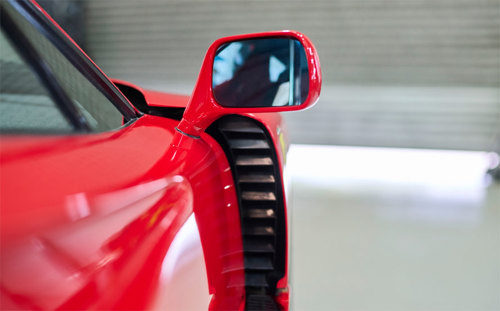
Image courtesy of Barkaways
📘 1900–1930: Early life and racing origins
1908 — First encounter with racing
- Enzo attends the Circuit di Bologna with his father
- “I knew then what I wanted to be.” — a defining early spark
1919 — Joins CMN racing team
- Begins career as a racing driver
- Competes in Targa Florio
1920 — Alfa Romeo driver
- Joins Alfa Romeo and becomes one of their lead drivers
- Builds a strong reputation for consistency
📘 1930–1950: Scuderia Ferrari and war years
1929 — Founding of Scuderia Ferrari
- Established initially as Alfa Romeo’s racing division
- Violet highlight: Birth of the Prancing Horse racing identity
1947 — First Ferrari road car: 125 S
- Ferrari launches its first branded car
- The iconic V12 engine makes its debut
1949 — First Le Mans victory
- Ferrari wins the Le Mans 24 Hours, securing global prestige
📘 1950–1980: Formula 1 dominance and global recognition
1950 — Entering Formula 1
- Ferrari joins the inaugural F1 season — the only team to compete in every season since
1952–1953 — Alberto Ascari era
- Ferrari secures back‑to‑back F1 championships
1969 — Fiat Group partnership
- Fiat acquires a 50% per cent stake, boosting Ferrari’s manufacturing capacity
- Strategic shift: Ferrari transitions from niche to global brand
1980s — Iconic road car era
- F40 development begins — Enzo’s final personally approved car
📘 1988: Enzo Ferrari’s passing
14 August 1988 — Enzo dies at age 90
- The F40, the last car approved by Enzo, becomes a symbol of his legacy
📘 Post‑1988: Ferrari Models released after Enzo’s death
1989 — Ferrari 348
- First major road car developed entirely without Enzo’s oversight
1994 — Ferrari F355
- Widely regarded as the return of Ferrari finesse and drivability
1999 — Ferrari 360 Modena
- A new design direction with an aluminium space frame
2002 — Ferrari Enzo
- Hypercar named in his honour
- V12, carbon fibre chassis, F1‑inspired systems
2009 — Ferrari 458 Italia
- Major technological leap: dual‑clutch gearbox, groundbreaking aerodynamics
2013 — LaFerrari
- Ferrari’s first hybrid hypercar
- Celebrates innovation rooted in Enzo’s philosophy:
"The best Ferrari is the one we’ve yet to build."
2017 — 812 Superfast
- Most powerful non-hybrid V12 production Ferrari
2022 — Ferrari Purosangue
- Ferrari’s first four‑door, four‑seat model
2023–2026 — Hybrid and electric era
- SF90 Stradale / Spider (plug‑in hybrid)
- 296 GTB / GTS (V6 hybrid)
- Ferrari's first full EV expected before 2030
Talk to our specialist team today Call us Email us
The story behind Cavallino Rampante: Ferrari’s prancing horseLong before it became the world’s most recognisable motoring emblem, Ferrari’s Cavallino Rampante blazed across the skies during the First World War. The black prancing horse was originally the personal insignia of Italian flying ace Francesco Baracca, and was painted on the side of his aircraft from 1917 onward. After his death as a fighter pilot during the war, the symbol gained legendary status, cherished by his parents, Count Enrico and Countess Paolina Baracca.
After claiming victory at the 1923 Circuito del Savio motor race, Enzo Ferrari was introduced to Francesco’s parents, Count Enrico and Countess Paolina Baracca. In a gesture of respect and belief in their son’s legacy, the Countess encouraged Enzo to adopt the emblem for good fortune on his racing cars. Ferrari took the black horse exactly as it was but added a vibrant Modena yellow backdrop – chosen as a tribute to his hometown – and, in doing so, transformed a pilot’s symbol into a motorsport icon.
The emblem first appeared on Scuderia Ferrari cars in 1932, signalling the birth of a brand identity built on speed, heritage, and national pride. What began as a symbol of courage in the air became the enduring crest of performance on the road and track – still prancing, still defiant, still unmistakably Ferrari.