
01 June 2026
Sixty glorious years! Happy birthday to the Aston Martin DB6
4 minutes
Sixty years ago in autumn 1965, these things happened. The Magic Roundabout made it’s circular and trippy first appearance on TV, the Post Office Tower opened in London, the Beatles were made MBEs, and one more thing… the Aston Martin DB6 made its impressive debut at the London Motor Show. This Grand Tourer summed up the decade being a revolutionary drive, evolutionary icon, and firm favourite of the famous, including King Charles III, Paul McCartney (a great way to mark his honour) Mick Jagger, Twiggy, and Peter Sellers. We’re taking a metaphorical ride through the history and high points of this legendary classic car that made its mark from 1965-1971.
Following in the wheel marks of its predecessors, the DB4 and DB5, the DB6 shared some physical (some might say superficial) characteristics with those models that had come before, but what stopped most Aston Martin fans in their tracks was the differences. Among these were the split front and rear bumpers, and rear panels, which incorporated the Kammback tail rear end. This final detail, when matched with a repositioned rear-axle and 3.75-inch (95 mm) lengthened wheelbase, created extra stability and balance for those more high-adrenalin, high-speed drives, and stopped that back end from lifting as well.
In retrospect, one might think that this would get a big thumbs up from the Aston Martin crowd. Initially though, this was not the case. AM loyalists were a little sniffy about what these modifications brought to the performance experience, with trial top speeds of 152mph not being that much of an improvement on the Vantage stats of 148mph. After all, the DB5 had secured its place in popular culture by featuring alongside 007, sweeping up some seriously cool car credentials.
The changes that elevated the DB6
Beyond those initial speed tests, it was the other points of difference that made the DB6 race ahead of its competitors sixty years ago.
At a time when space-age and sci-fi movies and TV series were gaining in popularity (Thunderbirds were ‘Go’, Doctor Who was vanquishing their first daleks), ahead-of-its-time features captured this trend, while still giving the unmistakeable appearance of an AM classic. The Armstrong Selectaride cockpit-adjustable rear shock absorbers from the DB5 were continued into the DB6, alongside front-door quarter windows, quarter-bumpers for every corner, split front and rear bumpers, reconsidered and updated tail-lamp clusters, plus an oil-cooler air scoop low on the front valance. This model also gained an overall extra two inches in length thanks to an enlarged spoiler – but who’s counting?
There was plenty of attention paid comfort details, too. The roof line was lifted by two inches and leg room made more generous, giving rear seat passengers the chance to sit at full height, stretch their legs, and appreciate the drive.
Other optional extras included power steering, air conditioning, as well as 185VR15 Pirelli Cinturato CA67 radial tyres while those in the purchasing market had the choice of a standard ZF five-speed manual unit or a BorgWarner three-speed automatic gearbox.
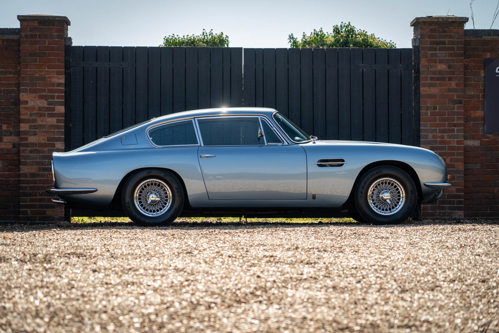
Image courtesy of Chiltern Aston, the original and longest-standing Aston Martin Independent Approved Repairer, showcasing the DB6 Saloon
Changes to the chassis
You can’t talk about the DB6 without making mention of a significant alteration to the construction technique. With the established and much lauded ‘superleggara’ method, where the alloy mainframe was supported by steel tubes of even size and strength over a steel punt chassis. This new model mixed things up with varying metal tubes and steel components that differed not just in material, but size, weight and strength – which made it more responsive and reactive (and less ‘one size/design fits all’) to where the steel support was fitted. And as the ‘Superleggara’ patent came with so much legacy, history, and sense of family, despite the chassis modifications, every DB6 initially featured the "Touring of Milan" and "Superleggera" patent/licence plate in the engine bay and "Superleggera" badges on the bonnet.
Under the DB6 bonnet – the lowdown on specs
The 4.0 litre in-line six cylinder engine was the designed by Tadek Marek – the genius behind the 1956 racing car Aston Martin DBR2 alloy straight six-cylinder engine, and a former rally driver himself. The powerhouse nerve centre of the DB6 was capable of 282 bhp (210 kW; 286 PS) at 5,500 rpm, with 325 hp (242 kW) at 5750 rpm if opting for the Vantage engine.
The DB6 also estimated at being 17lbs and 7.7 kgs more of a heavyweight than the previous iteration. The total kerb weight of the DB5 was 3,233lbs (1,466kgs) while the DB6 hit the scales at 3,250lbs (1, 474kgs). But, in small part due to that lengthened wheelbase, this new vehicle provided trusted stability when racking up the speed.
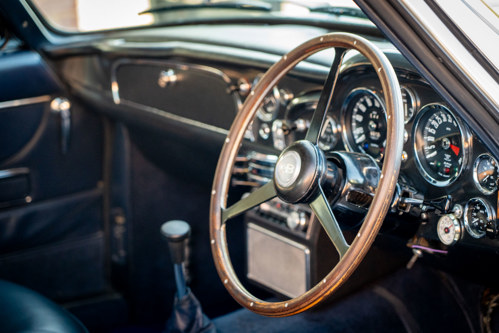
Image courtesy of Chiltern Aston, the original and longest-standing Aston Martin Independent Approved Repairer, showcasing the DB6 Saloon
Later models
A year following the initial launch in 1966 and also at the London Motor Show, the convertible style Volante made its top-down entry to automative society. Some of the later ones to roll into production are now very much collector’s items. It’s reported that King Charles still owns one, which he’s converted onto a more sustainable electric platform.
After four years building up a solid following, and at almost the same time humans made the first moon landing, the DB6 Mark II was launched in summer 1969. Standing out with its front and rear wheel arch flares and wider 205VR15 Pirelli tyres, these changes suggested that the Aston Martin teams wanted to create an even stronger visible presence for the car. This outer aesthetic was not the only change; performance-enhancing options included the AE Brico electronic fuel injection that combined with a higher compression ratio cylinder head.
The DB6 in popular culture
This is a great point to reverse back into the world of James Bond. The DB6 may have made more of an impact in ‘On Her Majesty’s Secret Service’ than George Lazenby’s acting, thanks to its unforgettable part in a climactic finale, plus all the gadgetry that was installed.
Secret agents aside, as we said at the beginning, the DB6 brought something different to the classic motor world than the DB5, igniting that rebellious spirit and entitled insouciance for those that could afford such luxuries. Mick Jagger, proving once and for all that he really couldn’t get no satisfaction, famously wrote off his one in front an audience of fans.
And where are prices at right now if you’re in the market for buying? According to Classic valuer, the lowest price in recent years was recorded at £36, 043. That's far from typical as the average is £171, 318, and the highest £272, 200,
As the slightly more streetwise sibling of the DB5, we say a heartfelt thank you to the short-lived but impactful DB6. As sweet at sixty as it was in 1965.