

21 October 2026
A story to tell: mourning jewellery - history lovers keep the market buoyant
6 minutes
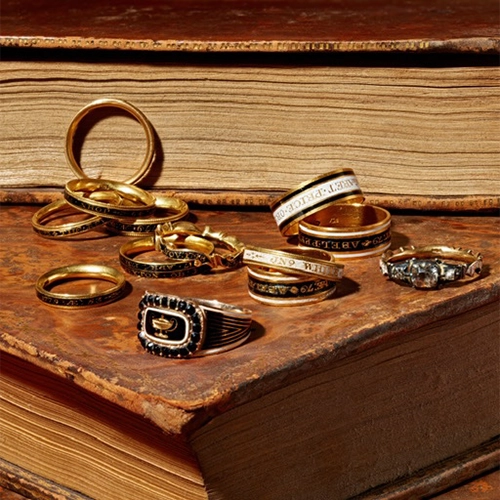
For collectors, antique jewellery offers far more than precious metals and gemstones. Many pieces provide a tangible connection to the past, carrying the stories of the people who owned, wore and commissioned them. Few categories illustrate this better than mourning jewellery, where historical significance and provenance can be just as important as the piece itself. We spoke to Catrin Jones, Senior Specialist in Roseberys' Jewellery and Watch department, about the enduring fascination with mourning rings, the stories that drive collector interest, and why demand remains strong for these remarkable pieces of social history.
It’s the chase that excites vintage jewellery collectors – none more so than mourning jewellery from the pre-1800s to the early 1900s. This market remains particularly strong with serious buyers looking for fine examples, rarity and a story behind each item. During the Georgian and Victorian eras it was common practice for wealthy people to bequeath mourning rings to close friends or family members.
There are also some famous examples – diarist Samuel Pepys, who died in 1703, recorded buying and bequeathing 123 mourning rings to be given to relatives as well as his associates in high office. For Vice-Admiral Lord Nelson (1758-1805), a set of 58 gold and enamel rings were commissioned by his brother, Dr William Nelson, after Nelson died at the Battle of Trafalgar in 1805. The rings were crafted by Nelson’s jeweller, John Salter, and given to close family, friends, pallbearers and every admiral and post-captain who fought at Trafalgar. In 2008, one of the rings sold for £18,000 at auction. Other surviving examples can be seen in institutions such as London’s British Museum, the National Maritime Museum, Greenwich, and the Victoria and Albert Museum. Mourning jewellery in top condition is becoming harder to find because pieces are often worn, damaged or sometimes melted down. As a result, when history-loving collectors track down handmade rings or jewellery in pristine condition, there is always a lot of interest.
Most mourning rings were made of gold with the name and date of the deceased enamelled on the inside or outside.
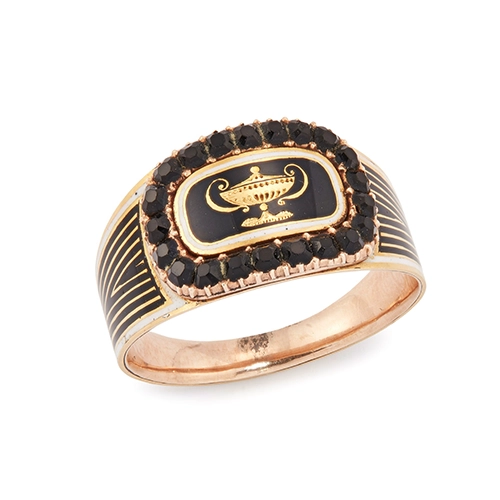
| By the late 17th century elaborate rings began to appear engraved and enamelled on the outside with symbols of mortality such as the full skeleton, skulls, an hourglass and even grave digging tools. Some Georgian rings are decorated with urns and weeping willows, cherubs and angels. From the mid 18th century mourning rings began to undergo a change. The memento mori (“Remember you must die”) iconography gave way to more delicate, sentimental designs that reflected changing attitudes to death. At the time, high mortality rates from diseases such as tuberculosis, diphtheria and smallpox, many of which claimed the very young, fuelled the demand for mourning jewellery. The death of Prince Albert in 1861 left Queen Victoria in despair and she went into deep mourning. This response was echoed in Victorian society and a variety of mourning jewellery was readily available, although much was of dubious quality. By the early 19th century, styles changed and the rings tended to be plain flat bands without the scroll decoration. (Image: George III mourning ring with urn. Sold £853. Estimate £400 - £600) |
The Peyton Family Collection
Collectors particularly enjoy researching the family tree and stories of the deceased, so our recent Peyton Family collection generated considerable interest because it featured five 18th-century mourning rings inscribed with the names of Peyton family members. Alongside the jewellery were family portraits in the Old Masters sale, so collectors could put a face to the person named on the rings.
(Image: Rings from the Peyton Family Collection) |
(Image: Portrait of Abel Peyton) |
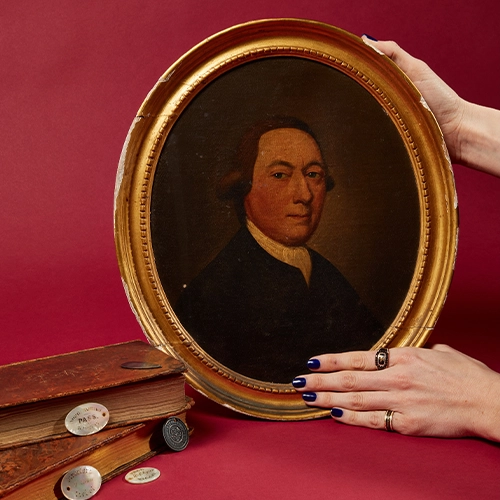
The Peyton Family has a long history to explore. They were descended from William Malet de Graville, who was present at the Battle of Hastings in 1066. He took the name of Peyton in the 12th century when Reginald Peyton, grandson of William Malet, was given land in return for pledged service to the Earl of Norfolk in the manors of Peyton.
Members of the family emigrated to Ireland and New Zealand in the 1860s and the USA in the 17th to 19th centuries.
It is this sort of heritage that adds provenance to auction lots as collectors can search ancestry sites or travel to discover much more about the people named on the jewellery.
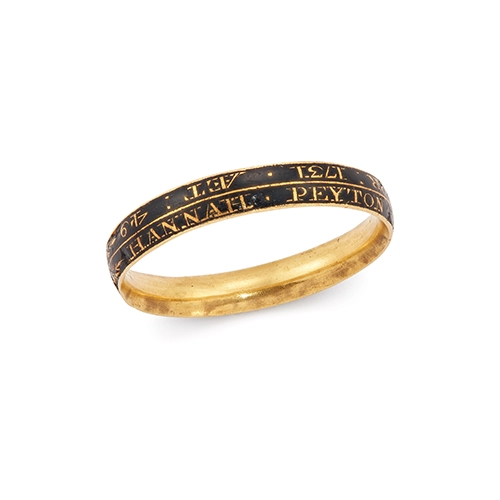
The Peyton Family pieces all achieved well above their estimates. A George III gold enamel double mourning ring engraved with names Richard Peyton (1682-1731) and Hannah Peyton (1687- 1757). The ring sold for £1,312, more than four times the top estimate of £200-£300. The band was divided into two halves, each bearing a name and date of death. It’s quite rare to see two people commemorated in the same ring.
(Image: George III gold enamel double mourning ring engraved with two names. Sold for £1312. Estimate £200-£300) |
(Image: Two George III gold, black and white enamel rings. Sold for £1,574. Estimate £500-£700) |
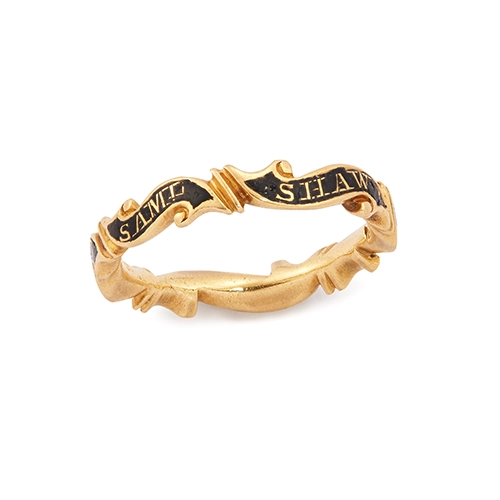
(Image: A scroll style George II gold and enamel mourning ring to remember Samuel Shaw. Sold £1,181. Estimate £300-£500) |
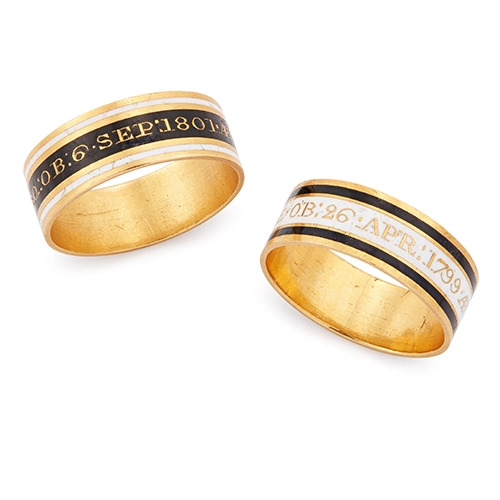
Two George III gold, black and white enamel rings sold for more than twice the estimate, achieving £1,574 (estimate £500-£700). The first had a central black enamel band commemorating Abel Peyton (1722-1801), with his age and date of death within a white enamel border and London hallmarks. The second, commemorating Margaret Price, had a central white enamel band recording her age, 81, and date of death, 26 April 1799, within a black enamel border, and also bore a London hallmark. A collector would no doubt be keen to work out the connection.
A scroll-style George II gold and enamel mourning ring to remember Samuel Shaw (1698-1748) achieved £1,181 against an estimate of £300-£500. Samuel Shaw (1698-1748) was the father of Hannah Shaw who married Abel Peyton (1722-1801) in 1748. Samuel Shaw was the grandson of Samuel Shaw (1635–1696), a nonconformist minister who was appointed rector of Long Whatton, Leicestershire in 1658 by Oliver Cromwell.
Top tips when buying
Mourning rings are enamelled, with the enamel often covering the entirety of the ring, so they cannot be sized. If you're thinking of buying one to wear, visit the auction house before the sale to check the sizing.
If you want to wear a mourning ring, 18th century rings often have interesting scroll designs, such as ribbon scrolls with a curved profile on the inside and, importantly, they are very comfortable to wear.
For something more unusual, look for rings enamelled in white, rather than black, as these were usually for children or unmarried people who died young. Mourning rings set with stones are also sought after, particularly those featuring a single foiled amethyst or chrysoberyl, typically a yellow to green stone.
Check if the ring has been repaired and look for chips and scratches to the enamel. Rings in the most original condition will be worth more than those that have been repaired. This is true for all antique jewellery but particularly so with mourning rings as the enamel can damage fairly easily and is not a straightforward repair.
For more information contact Catrin at catrinjones@roseberys.co.uk
About Catrin Jones
Catrin has been the Senior Specialist in Roseberys’ Jewellery and Watch department since 2023. She joined the jewellery trade at the age of 14, working at a traditional jewellers throughout her schooling and during university holidays. Following university, she was awarded a major scholarship to study gemmology and diamond grading at the Gemological Institute of America, gaining her Graduate Gemologists Diploma, and shortly after her Certificate of Appraisal Theory from the National Association of Jewellers. She worked for four years as a jeweller’s second-hand buyer and valuer before joining the jewellery department at Sworders auctioneers in 2019.
When she’s not at work, Catrin can usually be found scouring antique markets, cycling around London, or if it’s the weekend at a nice pub on the river!
Next jewellery auction
Roseberys Fine Art Auctioneers is a privately owned specialist fine art and antiques auction house and valuers based in south London. The next jewellery auction is on September 17, 2026. Visit roseberys.co.uk
Protecting and valuing a jewellery collection
Whether collecting mourning jewellery, antique rings or contemporary pieces, understanding the value of your collection is an important part of protecting it. Market demand, provenance and condition can all influence a piece's worth, making regular professional valuations an important consideration for collectors.
Our guide, Valuations: what an insurer expects, explains why insurers may require up-to-date valuations and how they can help ensure jewellery and other valuable possessions are insured accurately.
For further guidance, read Protecting your jewellery and watches: Why it pays to work with a specialist broker, which explores the benefits of specialist insurance arrangements for jewellery, watches and other treasured items.
If you would like to discuss your collection, contact the Howden Private Client team on 020 8256 4901 or email privateclients@howdeninsurance.co.uk
Related Products
Given that jewellery can be very expensive, we know how important it is that it’s protected properly with the right insurance.
What is a single article limit and why does it matter?
Protecting your jewellery and watches: Why it pays to work with a specialist broker