

04 November 2026
Celebrating 100 years of Winnie-the-Pooh
7 minutes
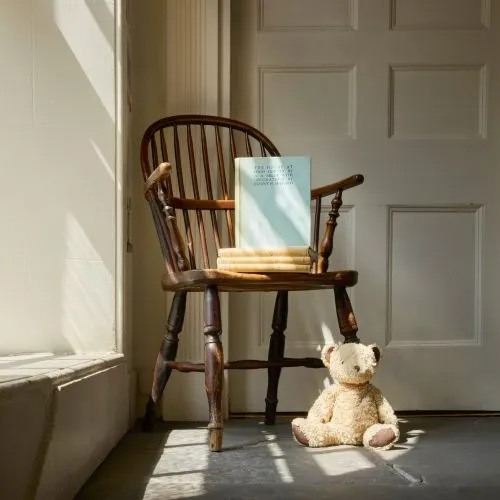
From treasured childhood stories to highly collectable first editions, Winnie-the-Pooh has captured imaginations for a century. We celebrate 100 years of A.A. Milne’s much-loved bear and explore the stories, illustrations and collectables behind his enduring appeal.
Our clients’ passions and interests are as individual as the things they choose to collect, preserve and enjoy. From art and literature to classic cars and treasured objects with a story behind them, these interests often have a significance that goes far beyond their value.
To celebrate Children’s Book Week, we look at one of Britain’s most enduring literary creations. We explore the story behind the much-loved bear, his remarkable legacy and why early editions and original illustrations continue to fascinate collectors.
A bear for the ages
First published in 1926, A.A. Milne’s Winnie-the-Pooh continues to evoke a wonderful sense of timelessness and nostalgia.
Combining A.A. Milne’s playful text with E.H. Shepard’s illustrations, Winnie-the-Pooh was published by Methuen in the UK and E.P. Dutton in the US on October 14, 1926.
A.A. Milne’s four much-loved books featuring Winnie-the-Pooh and his friends were When We Were Very Young (1924), Winnie-the-Pooh (1926), Now We Are Six (1927) and The House at Pooh Corner (1928). At the end of The House at Pooh Corner, Christopher Robin says to his favourite bear:
‘Pooh, promise you won’t forget about me, ever.
Not even when I’m a hundred.’
Of course, we haven’t forgotten the ‘Bear with little Brain’ and his friends Piglet, Roo, Tigger, Owl and Eeyore. The books were instant best-sellers and have never been out of print, being translated into more than 80 languages.
Cathy Tait, Head of Department, Rare Books at Lyon & Turnbull Auctioneers, says: “Every child wants to bring their teddies to life and Winnie-the-Pooh has been doing this, creating a world of living cuddly toys for 100 years.”
She adds: “As children, we are thrilled by the silliness and humour of the characters (think of Piglet being forced to have a bath and Pooh sitting on Eeyore’s prized ‘delicious’ thistle patch).
“While, as adults, we find comfort in Pooh’s contentment with the simple joys of life and we can still become happily lost in the Hundred Acre Wood.
“Whether you are eight or 80, Winnie-the-Pooh has something for you.”
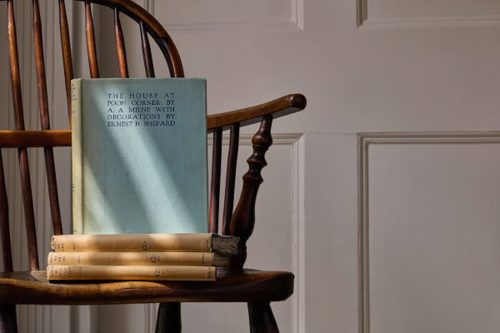
(Image: The House at Pooh Corner, signed by A.A. Milne and E.H. Shepherd, one of 350 numbered copies sold for £8,731.80. Credit: Lyon & Turnbull) |
So what’s the story of Winnie-the-Pooh?
Winnie-the-Pooh was originally a stuffed teddy called Edward Bear, until Christopher Robin, the son of author A. A. Milne, renamed him after seeing a black bear, Winnie, at London Zoo.
In the introduction to the book Winnie-the-Pooh, the author explains the name Pooh came from Christopher Robin’s toy swan: “That was a long time ago, and when we said good-bye, we took the name with us as we didn’t think the swan would want it anymore”.
A.A. Milne took inspiration from Winnie and Christopher’s other stuffed animals, writing stories about their adventures in the fictional Hundred Acre Wood based on Ashdown Forest, in East Sussex near their home at Cotchford Farm.
About the real Winnie
Winnie was originally from Winnipeg, Canada. She had been rescued by a veterinary surgeon, Lieutenant Harry Colebourn, who was on his way to the battlefields of France, via England, to tend horses during the First World War. The bear became his regiment’s mascot.
According to Colebourn’s great-granddaughter, Lindsay Mattick, speaking to The Guardian newspaper, Lieutenant Colebourn realised the front line was no place for a bear so he borrowed a car from a fellow officer and drove Winnie from the Salisbury Plain to London Zoo.
He asked the zoo to look after Winnie until the war was over, but it became clear to Lieutenant Colebourn that Winnie had there, London Zoo remained her home from 1914 to 1934.
Celebrating Winnie-the-Pooh’s 100th birthday
See Winnie statues at London Zoo
London Zoo (ZSL) remembers the real Winnie with a statue of Lieutenant Harry Colebourn and his bear near Butterfly Paradise. A special adventure trail, A Little Boy and his Bear: A Storybook Adventure, runs to November 1, 2026, celebrating 100 Years of Winnie-the-Pooh and 200 Years of ZSL. Visit londonzoo.org
Listen in
On BBC Sounds, actors Toby Jones, Jim Broadbent, Lenny Henry, Ambika Mod and Hayley Attwell bring Winnie-the-Pooh stories to life in five new audiobooks.
Listen to bbc.co.uk/sounds/series/m0032qnf
Victoria and Albert Museum
The V&A Museum in London holds an extensive collection of E.H. Shepard’s original pencil illustrations for Winnie-the-Pooh and The House at Pooh Corner which can be viewed by appointment. This includes more than 270 drawings and related letters, as well as proofs and photographs.
Brighten up your post
The Royal Mail is marking the centenary with a Winnie-the-Pooh Limited Edition Prestige Stamp Book. Only 3,000 will be released on November 26, 2026, priced at £49.99.
If you would just like to brighten up your post, a book of four Winnie-the-Pooh First Class stamps costs £7.20. A set of six stamps featuring Winnie-the-Pooh, Piglet, Owl, Eeyore, Tigger, and a scene with Pooh and Christopher Robin costs £10.80, while a 10-stamp presentation pack featuring both sets costs £18.90.
Visit shop.royalmail.com/winnie-the-pooh-stamp-book
Pooh sticks in East Sussex
If you fancy playing Pooh Sticks, invented by Winnie-the-Pooh, go to Ashdown Forest.
You need two or more players, each with a Pooh stick (collected from the forest) to stand on Pooh Sticks Bridge.
Check which way the water is flowing so that, when sticks are dropped, they will be carried by the current underneath the bridge.
On the count of three, every player must drop their Pooh stick into the water.
Players then cross the bridge and wait for their stick to appear on the other side. The first stick to emerge is the winner!
Leave your car at Pooh Car Park, TN7 4EX (Chuck Hatch Lane, about 1 km away).
New York Public Library, US
The original Winnie-the-Pooh and friends Piglet, Eeyore, Kanga and Tigger are now part of the Treasures collection in New York Public Library, playing a central role in the continuing legacy of Winnie-the-Pooh. The toys were brought to the United States in 1947 to be displayed by publisher E.P. Dutton before being permanently handed over to the library.
Queen Camilla’s gift
Christopher Robin’s toys at the New York Library have recently been repaired by a specialist conservator while Roo is a new addition to the ‘family’.
Roo, who was lost in an apple orchard in the 1930s, has been specially re-made by the original toymaker, Merrythought, and Queen Camilla gifted the 3.5-inch replacement Roo to the library during a state visit to the US earlier this year.
Disney films
Disney bought the rights to Winnie-the-Pooh in the 1960s and by 1966 the bear and his friends leapt from book to screen, appearing in Disney’s Winnie the Pooh and the Honey Tree. In 1968, Winnie the Pooh and a Blustery Day won the Oscar for Best Animated Short Film while the 1974 Winnie the Pooh and Tigger Too was nominated in the same category.
Walk of Fame
Winnie-the-Pooh also has a star in the Hollywood Walk of Fame, placed at 6834 Hollywood Boulevard in 2006 to celebrate his 80th anniversary.
Guinness World Records
The Original Map of Hundred Acre Wood (1926) sold at Sotheby's London for £430,000 on July 10, 2018, setting the world auction record for any book illustration. It achieved almost three times its expected sale price.
Visit www.guinnessworldrecords.com
New Books
New books for the centenary, by James Campbell, include The Men Who Created Winnie-the-Pooh: The Lives of A. A. Milne and E. H. Shepard, £25, and The Art of Winnie-the-Pooh: How E. H. Shepard Illustrated an Icon, £15.
Winnie-the-Pooh books at auction
Several factors influence the value of an early A. A. Milne book, according to Cathy Tait, Head of Department, Rare Books at Lyon & Turnbull Auctioneers, who has auctioned individual copies of Winnie-the-Pooh, as well as signed limited editions and complete collections.
(Image: Exceptional first edition of When We Were Very Young, one of 100 numbered copies printed on handmade paper, signed by A. A. Milne and E. H. Shepard, achieved £19,051.20 Credit: Lyon & Turnbull) |
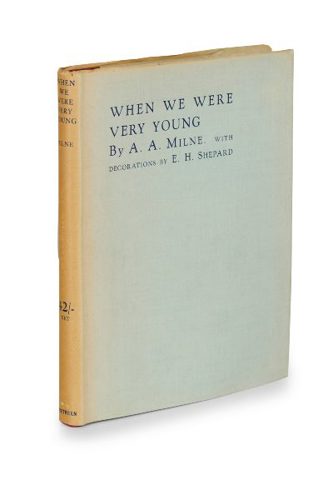
Special editions can achieve excellent prices and Cathy said: “As an example, an exceptional first edition of When We Were Very Young, one of 100 numbered copies printed on handmade paper, signed by A. A. Milne and E. H. Shepard, achieved £19,051.20.
“Another first edition, The House at Pooh Corner, signed by A.A. Milne and E. H. Shepard, one of 350 numbered copies printed on handmade paper including a folding map of Hundred Acre Wood, sold for £8,731.80.”
Cathy Tait’s guide to buying early Winnie-the-Pooh books
Edition and impression. The earliest printings are generally the most desirable. Books that proved popular immediately, as A.A. Milne's did, were often reprinted quickly, making accurate identification important.
Condition. Original bindings, clean pages and well-preserved illustrations all contribute to value and the presence and condition of the original dust jacket can be significant.
Signatures and inscriptions. Copies signed by A.A. Milne are collectable, while those signed by both A.A. Milne and E.H. Shepard have the additional distinction of bringing together the author and illustrator.
Limited editions. Small print runs of the deluxe editions make them considerably scarcer than standard copies.
Provenance. Original ownership records, presentation inscriptions and associated correspondence can help establish a book’s history. A collection offered by Lyon & Turnbull in 2024 was notable for having remained in one family since publication.
Complete sets. Collectors may seek all four original Pooh books, particularly where the editions, bindings and condition are consistent.
How to identify an early A.A. Milne First Edition
If you own an early copy of Winnie-the-Pooh or another A. A. Milne title, the first step is to examine the publication details.
The title page, publisher’s information and statements concerning subsequent impressions can help establish when the book was printed. The binding and dust jacket should also be examined, as these may distinguish an early copy from a later edition. Signed limited editions generally include a limitation statement identifying the edition, together with the signatures of A.A. Milne and E.H. Shepard.
(Image: Credit: Lyon & Turnbull) |
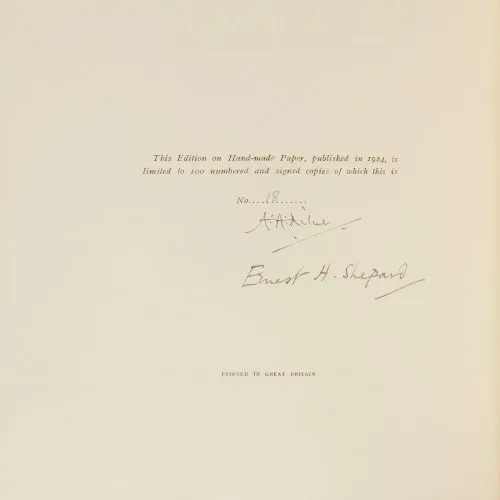
It is important not to assume an old copy is necessarily a first edition. A specialist assessment can establish the edition and impression, examine the condition and determine whether any signatures, inscriptions or ownership history contribute to its significance.
Visit lyonandturnbull.com
Could there be value hiding on your bookshelf?
A much-loved childhood book may hold mainly sentimental value, but occasionally the things we have lived with for years can be worth considerably more than we realise. It’s something professional valuers encounter regularly. During a walk-through valuation, for example, Mark Smith ASFAV, Director at Quastel Associates, came across a first edition of J.R.R. Tolkien’s The Hobbit that, despite being in less-than-perfect condition and missing its dust jacket, was valued at around £20,000. On another occasion, an inherited piece of studio pottery, thought to be worth only a few hundred pounds, was valued at £15,000.
Books, art, antiques and collectibles can change significantly in value over time, which is why it can be useful to periodically review both what you own and what it might cost to replace. A professional contents valuation can help identify items of significance, establish appropriate values and provide a clearer picture of the overall value of the contents within your home.
For insurance purposes, an up-to-date valuation can help you understand whether your contents sum insured and the values recorded for individual items remain appropriate. If you are unsure whether your contents cover reflects what you own today, the Howden Private Client team can discuss your circumstances and, where appropriate, help arrange a professional valuation.
After all, as the world of Winnie-the-Pooh collectors shows, sometimes the things sitting quietly on our bookshelves may be more significant, and more valuable, than we realise.
To speak to the Howden Private Client team, call 020 8256 4901 or email privateclients@howdeninsurance.co.uk
Related Products
From jewellery, antiques, netsuke, art and zithers - collectibles insurance to protect your treasure.
What recent art thefts can teach collectors about protecting their collections
What is a professional home contents valuation and why does it matter?