

11 November 2026
It’s not just a champagne moment, England’s top sparkling wine is fizzing with potential
7 minutes
English wine has come a long way in a relatively short space of time. Growing international recognition, expanding vineyard acreage and changing growing conditions are creating new opportunities for established producers and those considering investing in viticulture.
But wine production remains closely tied to the land, the weather and the individual characteristics of each site. As the 2026 harvest got under way, I spoke to Brad Greatrix, Senior Winemaker at Nyetimber, about the challenges of this year's growing season and why he remains excited about the potential for English sparkling wine.
It’s September 22, 2026, and the wine harvest is already under way. That’s a week earlier than last year and a month earlier than 2006 when Eric Heerema bought Nyetimber Estate and hired winemaking couple, Brad Greatrix and Cherie Spriggs, to craft the finest English sparkling wines.
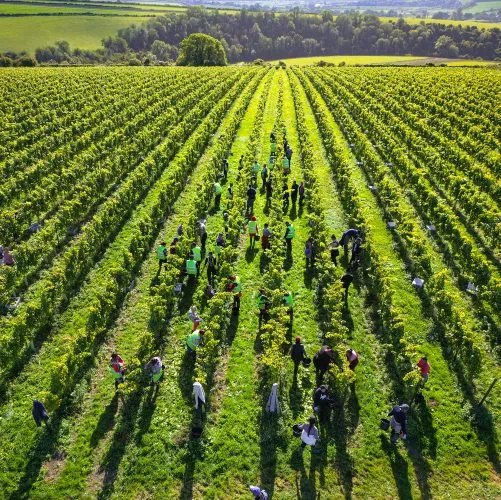
This summer, long days of scorching sunshine have warmed Nyetimber’s south-facing slopes and 500 workers arrive to hand-pick the grapes. Despite very little rain, Brad is full of optimism. He said: “This year, the potential of the grape quality is very high – although it’s not going to be a straightforward vintage; we started with severe late spring frosts and we had little rainfall from June until the beginning of September.
“We're trying to fully exploit the warmer growing season and when the harvest date moves forward we can pick at an optimum moment. I’m really excited because the quality’s there but I feel we’ll have to earn it. We're not coasting down a mountain on a bicycle, we're running up a steep hill.
“For all the success that we’ve had up to now, when it comes to quality, we are at base camp because there’s still so much unfulfilled potential.”
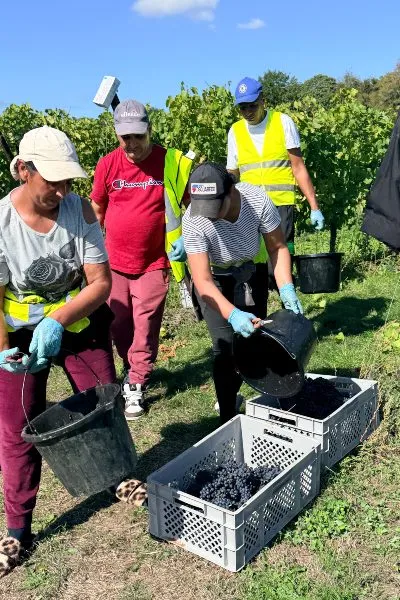
(Image: Pickers fill crates with grapes at Nyetimber) |
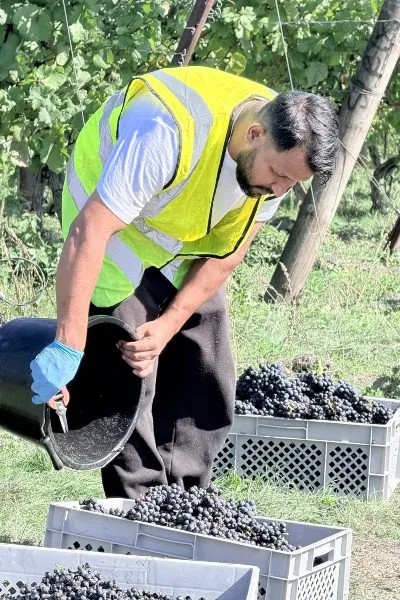
(Image: Grapes are carefully put in a bucket before being put in 15kg crates for the pressing centre) |
Nyetimber’s first global acclaim came after another good summer, 2018, when Head Winemaker Cherie Spriggs won Sparkling Winemaker of the Year at the International Wine Challenge – the first time the trophy was awarded to someone from outside of Champagne. She won again in 2025 and remains the only woman ever to have done so.
The drought this year means yields will be lower than 2025, which saw more rain, so this year the focus is on quality over quantity and Brad expects to produce 1.5 million bottles, against a maximum capacity of two million.
Brad said: “The weather is always on our mind. In past years we have always had the advantage of a very long growing season and that’s partly why sparkling wines are so successful. All that time on the vine means flavours accumulate and we can preserve very delicate, very pretty and elegant flavours. Now the change in climate creates new opportunities.
(Image: The 2026 harvest under way across Nyetimber’s vineyards) |
Coping with extreme heat
Regarding this year’s exceptional temperatures, Brad said: “Vines can cope with extreme heat – historically, classic wine-growing countries see temperatures in the mid-to-high 30Cs.
“Whatever the weather, we always start monitoring the ripeness of the grapes very early, taking samples to the winery and measuring sugar and acidity. The checks can be done in the lab from the middle of August so we can begin to see which grapes are ahead, or which are behind, and as we get closer to the time, we know there’s going to be enough sugar, and the acidity is going to be low enough.”
Colours on a palette
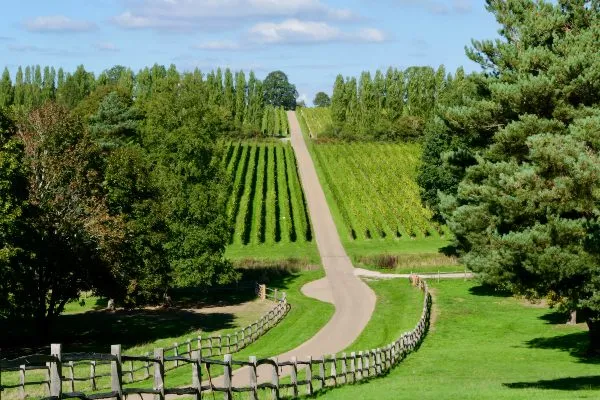
Eric Heerema bought the 35-acre Nyetimber estate, on the lee of the South Downs in West Sussex, in 2006, recruiting Head Winemaker Cherie and Senior Winemaker Brad, in the same year. Today, Nyetimber has around 430 hectares of vines across 11 vineyards in West Sussex, Hampshire and Kent. Each vineyard is on greensand or chalk south-facing slopes which are no more than 100 metres above sea level. The vineyards are planted with the holy trinity of sparkling wine grapes – Chardonnay, Pinot Noir and Pinot Meunier.
(Image: The 2026 harvest under way across Nyetimber’s vineyards) |
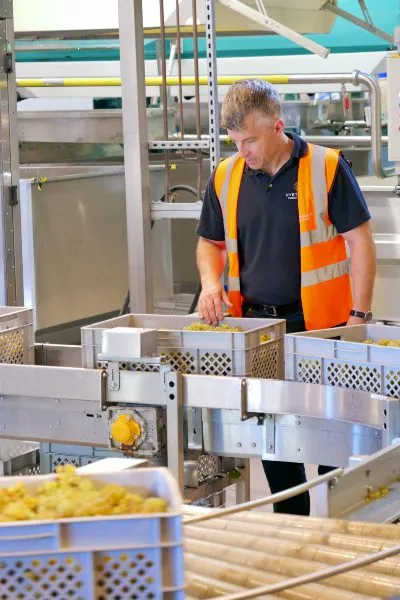
| Planting started in the three Kent vineyards in 2017 – Chartham, near Canterbury; Lacton in Westwell, near Ashford and Thurnham on the foot of the North Downs near Maidstone. These vineyards now make up 44 per cent of Nyetimber’s acreage and this has allowed production to triple in the last 10 years. Brad said: “We always had the idea that the company would grow but we wanted to make things even better. Soil is a critical criterion plus other topographical features and microclimate. “When introducing grapes from Hampshire and Kent, we think of it like colours on a palette. It can help us provide diversity in base wines, which are the raw ingredients for the blends we produce." “We have points of difference; some Pinot Noir that’s a little bit more floral and some Pinot Meunier that’s a little bit more red-fruited. Every vintage in England is distinctive. “We react to the season. Sometimes the Pinot Noir is very expressive and has a clear flavour profile while some years we need 40 or 50 per cent in the blend and other years it can be 25 or 30 per cent. It’s like tuning a radio to find adjustments that we want. “Our biodiversity also feeds into this – every second row of our vines is left wild with cover crops to grow naturally. This provides some complexity because it helps to keep pests at bay and creates a habitat for insects and small animals. And, on a bigger scale, a large proportion of our land in West Sussex is given over to rewilding. Just because the land doesn’t suit viticulture, it still helps create a healthy and complex ecosystem as we let nature take it back. “We even get badgers in the vineyards. They love the Pinot Noir grapes and on the bottom rows we often find just the stalks where they have enjoyed the juicy fruit!” (Image: Grapes are inspected at Nyetimber’s pressing centre as part of the winemaking process) |
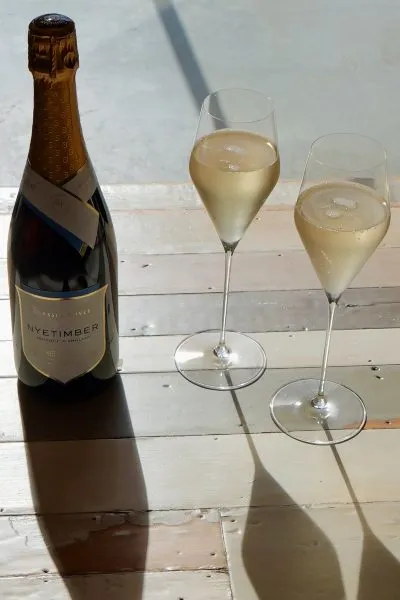
| A time for investment?England is now the fastest growing sparkling wine region in the world and three-quarters of the wine that is produced is sparkling wine. Brad believes English sparkling wine has two characteristics that may appeal to investors. He said: “The wine ages extremely well and investors can have the confidence to put it away for 10 to 20 years. It is enhanced by being aged at a consistent temperature with protection from light. “Secondly, there is still a niche or novelty aspect to English sparkling wines. Especially overseas, the wines get put through the wringer in terms of blind tastings and competitions but we always hold our own. Nyetimber is particularly popular in Scandinavia, Germany, the Netherlands and Japan. “And, while the majority of the wine world is being challenged by the climate getting too warm with wine producers going higher in elevation, here, we want to stay as low as possible to keep warm. By October, certainly late September, the sun is on a lower path so south-facing slopes help intercept more energy from the sun.” Visits to Nyetimber are by appointment only. Open Day tours, dining experiences and special events can be booked online at nyetimber.com (Image: Nyetimber Classic Cuvée, produced from grapes grown across the English vineyards) |
Kent: The new vineyard of England
The Garden of England is increasingly becoming the Vineyard of England, with Kent now one of the country's most significant wine-growing regions.
Sparkling wine producers are moving in to take advantage of the chalky soils and temperatures that mirror those of the Champagne region in France.
They include Domaine Evremond, founded by friends Pierre-Emmanuel Taittinger and Patrick McGrath, a Master of Wine, wafter they bought 150 acres in Chilham, near Canterbury, in 2015.
India McGrath, head of sales and marketing at Domaine Evremond, said: “It was a huge moment for English viticulture - the first time a Champagne house had planted vines in England, recognising the quality of sparkling wine.”
Domaine Evremond is also recording its earliest harvest in 2026. India added: “This year has been very dry but it is going to be another amazing year. We like a fresher style and don't want too much sweetness so the alcohol and sugar levels were where we needed them about two weeks earlier than usual.
“Our very first harvest was on October 23, 2019, but this year we started our harvest on September 18, more than a month ahead in a seven-year period.”
For tastings, tours, food pairing experiences and events visit domaineevremond.com or call 01227 696 055.
Protecting a growing vineyard
For those inspired by the potential of English wine, it is worth remembering that the insurance requirements of a vineyard can change considerably depending on its scale and how it operates.
A small vineyard that forms part of a home and is primarily a hobby may, in some circumstances, be accommodated by extending the home insurance, particularly where activities such as picking, processing, bottling and sales are contracted out. As a vineyard develops into a commercial enterprise, however, its insurance requirements can become more complex.
Commercial vineyards will typically need specialist cover for risks including liabilities, machinery and loss of income. The vines themselves bring another layer of risk. While risks such as fire and theft can be insured, weather-related damage can be significantly more expensive to protect against. Disease may also need to be considered.
Loss-of-income cover can also be an important consideration. This will generally only respond following insured material damage, so protecting against losses caused solely by the failure of vines due to weather can be more difficult and potentially expensive.
I discuss some of these considerations in more detail in The Telegraph’s article, As buy-to-let struggles, should you invest in an English vineyard instead?
If you own a vineyard, are considering establishing one on your property, or your hobby vineyard is beginning to develop into a commercial venture, talk to us. We can help you understand how your insurance requirements may change as your vineyard evolves and ensure your cover continues to reflect the risks you face.
Related Products
Key to our success is our exemplary service, made possible by a team of people who have the character and skill to manage, meet, and exceed the expectations of our clients.
Garden Insurance: Protecting Your Plants, Trees and Outdoor Structure
Rural machinery and tools: theft prevention and insurance