

08 December 2025
‘Indigenous art talks to me, I am obsessed’
8 minutes
Melbourne-born art dealer Jennifer Guerrini-Maraldi has travelled all over the Australian outback developing an eye for Indigenous contemporary art. She now lives in London and runs JGM Gallery specialising in work by First Nations’ artists, practising in both traditional and modern media
Travelling through the Australian outback, camping under a mosquito dome, does not faze Jennifer Guerrini-Maraldi. She loves the Australian wilderness and feels it’s the reason she connects with Indigenous art ‘because it talks about the landscape and the hardships of living in it’.
Jennifer explains: “I only really travel in the most remote areas. I've driven the Tanami track, across the Tanami Desert which links Mparntwe (Alice Springs) in the Northern Territory to Halls Creek in Western Australia.”
Jennifer also applies her keen intuition when choosing Indigenous art and says ‘I use my eye more than anything else to pick young and emerging artists’.
|
|
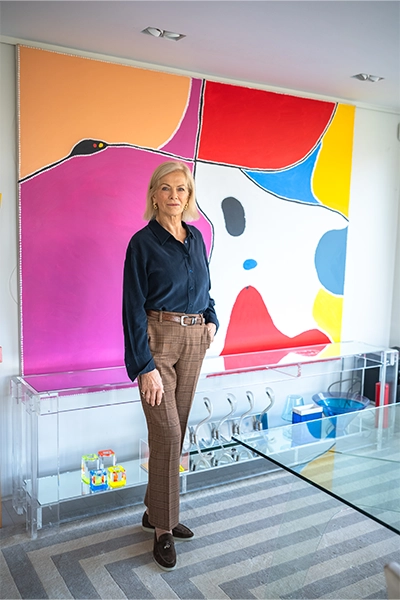
In the image above, Jennifer stands in front of a painting, ‘Sugar Bag’ by Freddie Timms, which she and her husband bought more than two decades ago in Sydney. She said: “When the Freddie Timms painting arrived in London and we hung it in the main entrance of our home, I felt as if it was following me around the house, saying something to me. I can't explain exactly what but with Indigenous art there’s always a story beyond what you see purely visually; you feel the presence of tens of thousands of years of history, storytelling, cultural morals and ancestral wisdom flowing through the paint. “For me, this is a big reason to have works like this in your home. They speak to an undying culture and a phenomenal web of connection across a vast continent. “Timms painted this piece in pretty abstract colours – not what you would necessarily expect from artists in the north Kimberley. He usually painted using natural ochres taken from the soil and rocks in this region, which he crushed into a fine powder with an acrylic binder. But for this one he used bright acrylic paints given to him by Sydney art dealer, Frank Watters, who asked him to give them a try. ‘Sugar Bag’ led to Jennifer’s obsession with First Nations’ Australian art. She loved it so much that she made it her business to support the movement’s artists and develop the discourse in London around their work. Jennifer said: “It was not just the art that I became interested in but the entire unbroken 65,000 -year -old (at least!) culture because it’s so intertwined. First Nations’ groups traditionally have no written language – stories and maps were made in the sand as well as ceremonial marks on the body in the years before the British colonised Australia. |
“Indigenous art had not made commercial galleries by the time I left Australia in the late 1970s. It was creeping in but you couldn’t see it in galleries in the saturated way you can today with fabulous premises in Sydney, Melbourne, Mparntwe (Alice Springs), Darwin and internationally.
“In fact, the British market has been quite slow in embracing Indigenous art compared to the rest of Europe. It may be because of the complex history about the colonies which British people feel towards Australia. I have clients in Zurich, Paris, Geneva, Rome and St. Moritz who have been collecting on a serious level for many years.”
In the United States, ‘Desert Painters of Australia’, an exhibition showing works from the collection of actor and comedian Steve Martin’s Indigenous art collection at Gagosian Gallery, New York, in 2019, propelled the genre further onto the radar of American art buyers. Martin has been collecting for years and owns one of the finest and most diverse private collections in the world.
Jennifer said: “Steve Martin has a warehouse just outside New York with thousands of paintings. He simply saw some Indigenous art and became totally obsessed and, as I know, that does happen to people.
“I also have collectors in America and, amusingly, I sell paintings back to Australia. I often have work that I've sat on for a while and then put up for sale. I've had great success choosing work early in an artist’s career. They are often paintings nobody else has, where I have used my eye to pick a special painting.”
|
|
‘A real buzz around Indigenous art’Jennifer says there is ‘a real buzz around Indigenous art’ at the moment and high-profile exhibitions continue to be a catalyst for more interest and, in turn, in higher prices. Jennifer said: “I bought a painting about 15 years ago and sold it at Sotheby's in New York this year for a lot more than I originally paid. It was a depiction of a desert landscape from an aerial perspective in a verdant palette by artist Alma Webou, of the Yulparija group. She was painting her birthplace, Pinkalarta, in the Western Desert, which she was forced to leave in the 1960s when a long period of drought depleted her people’s natural resources. Webou moved to Bidyadanga on the coast, and in a way, this relocation is reflected in her choice of pigments. In this painting, we see the artist’s sensitivity and response to her environment. That kind of sale doesn’t happen all the time but it is an illustration of what can be achieved. ”Again in the US, ‘The Stars We Do Not See’, an exhibition of Australian Indigenous art is also creating further interest at the National Gallery of Art in Washington. The curator Myles Russell Cook was formerly a senior curator of the Australian First Nations art at the National Gallery of Victoria in Melbourne. Jennifer highlights the Emily Kam Kngwarray exhibition, in Europe for the first time, which continues at the Tate Modern until January 2026. (Image: Pinkalarta by Alma Webou of the Yulparija group sold at Sotheby’s London. c. JGM Gallery) |

|
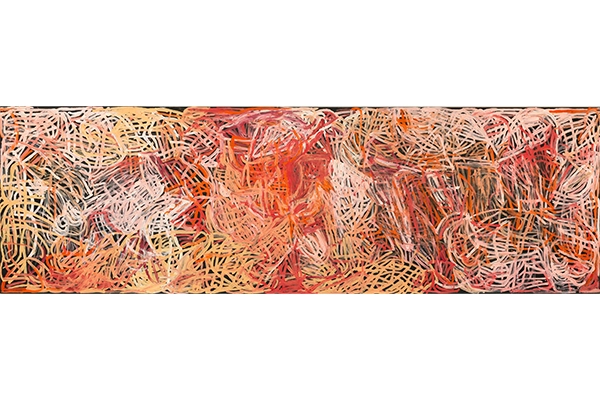
(Image: Emily Kam Kngwarra, Yam awely, 1995. NGA. © Emily Kam Kngwarray/Copyright Agency. Licensed by DACS 2025. Photo © Tate (Kathleen Arundell)) |
|
(Image: Emily Kam Kngwarra near Mparntwe Alice Sprints 1980. © Toby Sawenko) |
(Image: Emily Kam Kngwarra, Ntang Dreaming 1989. NGA, Canbarra. |


She said: “This is a blockbuster show brings in a wider audience as well investor interest, not only in her work, but other exceptional Indigenous artists including Rover Thomas and Sally Gabori. Interestingly, Kngwarray (1910-1996) never left her community despite fame in her own lifetime for her vast, gestural canvases and striking batiks.
“Her painting ‘Untitled (Alhalker)’ reached a record UK auction price of £635,000 (inc. buyer’s premium) at Sotheby's, London, in March 2024 while in Australia, her 1994 work ‘Earth’s Creation 1’ sold at the Cooee Art Gallery auction for 2.1 million Australian dollars (more than £1m), setting a record for an Australian female artist.”
Giving clients confidence
Jennifer says that as a gallery owner she always puts an ethical and conscientious approach to the industry and its artists first. She said: “That's really important as a dealer. JGM Gallery is a member of the Indigenous Art Code, which means I am approved by that body in Australia with professional obligations to be culturally competent, respectful and to avoid discrimination. This gives the client additional confidence that the artists are properly paid.
“For Indigenous artists, their contemporary practices are an avenue for self-expression, whether that’s connected to culture, politics or otherwise. I deal directly with government-approved and Indigenous -owned art centres where, in my opinion, the best work comes from.
|
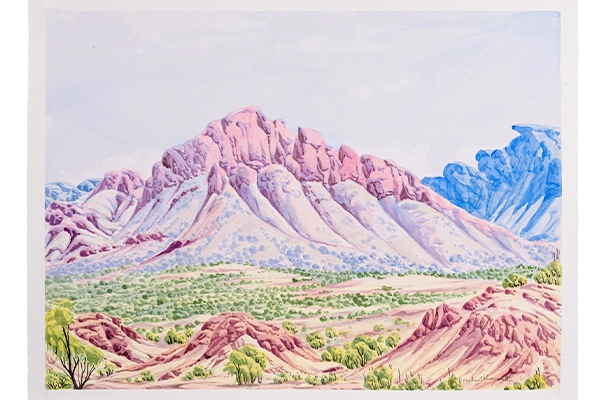
(Image: Across the Plains, 20024 watercolour on paper 52cm x 71cm by Hubery Pareroulta. C. JGM Gallery) |
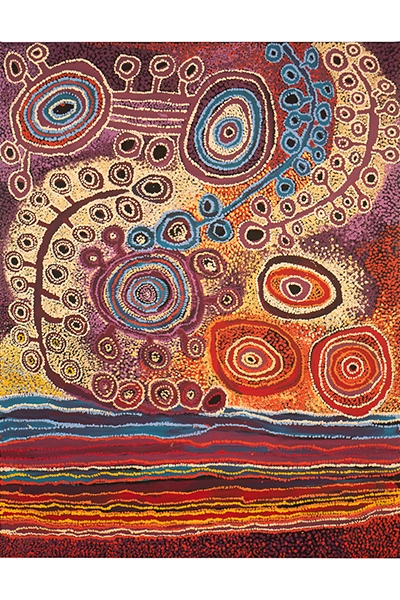
(Image: Seven Sisters Story 2023 Acryllic on linen 198cm x 152cm by Jennifer Ingkatji at the JGM Gallery) |
Konstantina’s ‘RE: Imagined solo exhibition
Investors circling the idea to buy Indigenous art can go to galleries, exhibitions and museums to view work without buying in the first instance.
Jennifer says this is certainly a way to become more connected and gain understanding of art from Indigenous Australia. She said: “At the JGM Gallery we have an upcoming exhibition of works by Gadigal multidisciplinary artist of the Eora Nation, Konstantina, inspired by her ongoing research project with the British Museum.
“The paintings in 'RE: Imagined' are influenced by objects from the Sydney region, where Konstantina is from, which are held in the Oceania collections at the British Museum. These objects number more than 6,000 and many have never been exhibited since they were taken from Indigenous communities in Australia.
Konstantina’s paintings respond to the materials and traditional techniques used to make these objects. For this exhibition, she is also ‘re-imagining’ possum skin cloaks. The individual panels of these garments were traditionally decorated with patterns using ochre and a scouring technique, but now Konstantina is modernising these objects using dextrous and detailed embroidery and beading. These pieces are especially stunning, and unlike anything I have seen before.
|
(Image: Barnal 1 2025 acrylic on linen 90.5cm x 75 cm. c. JGM Gallery) |

“Konstantina’s exhibitions have consistently sold out over the last five years, and this will be her first UK exhibition with prices from £1,000 to £10,000.”
Jennifer’s top tips on knowing what to buy
- As well as using your eye, read up on the history and biography of the artist.
- Check to see if the artist’s work is already in some good collections.
- Follow artists who have a very good CV (look out for the Telstra NATSIAA), who are collectible and well-thought of in terms of their own biography.
- Don’t buy a painting because you think it’s going to make money. If you walk into a gallery and see something that immediately speaks to you, this initial instinct is the one I try to get people to go with.
- Like every art movement there are good and bad artists so don’t just buy any artist.
- For each work, it’s important to have the certificate of authenticity, with a reference number that’s come from the Indigenous-owned Art Centre.
About Jennifer Guerrini-Maraldi
At 23, Jennifer became director of the Powell Street Gallery in Melbourne. She moved to the UK in 1978 where she worked in property developing and fashion and travel writing for Country Life.
She founded the JGM Gallery in Battersea in 2017. She has devoted herself to collecting, dealing and promoting the work of First Nations’ artists and, in addition to this, her gallery represents a diverse roster of both established and emerging British contemporary artists. Through its exhibition programme, JGM Gallery seeks to amplify the enduring significance of Indigenous art and culture, with a focus on the use of sacred processes, traditional techniques, and contemporary innovation.
Exhibition dates
‘RE: Imagined’, an exhibition of works by Gadigal woman of the Eora Nation, Konstantina, runs from October 29/Private View 6:30pm – 8:30pm) to December 6 at JGM Gallery, 24 Howie Street, London SW11 4AY. Visit jgmgallery.com
‘Emily Kam Kngwarray’ Tate Modern exhibition in London runs to January 11, 2026. Visit tate.org
‘The Stars We Do Not See’ exhibition at the National Gallery of Art in Washington runs to March 1, 2026. Visit nga.gov
Insurance and valuations
If you have an art collection you should check it has the correct insurance cover. You don’t always need a stand-alone policy to insure artwork, but it shouldn’t be insured as “Contents”. Our recommendation is that any art in any form is insured under the “Art and Antiques” section of your policy. Ensure there is a good description of each item, with size and images.
Remember that repairing is different to replacing. A collection can be damaged by smoke, or a painting can fall off a wall. In these instances, you may not want to replace a piece, but having the right insurance policy in place will cover the costs of repair and restoration, or compensate you for a depreciation in value. For more information on how to insure your art please read our article: Insuring your artwork.
We also recommend that you get an up-to-date valuation. Make sure the valuation is for insurance purposes and that documentation is kept in a safe, secure, but memorable place in the event of a claim. We have a panel of recommended valuation companies that can assist by not only valuing your pieces now, but by also giving you up-to-date valuations going forward. Some of the insurers we work with will give a 25 per cent or even 50 per cent uplift for three years following a valuation to protect policyholders from rising prices.
To speak to Howden about your art insurance call 020 8256 4901 or email privateclients@howdeninsurance.co.uk