

18 December 2025
Clamour for glamour
7 minutes
We all enjoy some sparkle at Christmas and Dreweatts Head of Jewellery Charlotte Peel shares her joy of 20th century jewellery.
Stories of passion and romance can bring valuable provenance to jewellery at auction – and it’s been quite a year at Dreweatts where we have seen a succession of wonderful pieces from the roaring 1920s through to the 1950s. And when it comes to vintage jewellery I believe in buying with your heart. If you don't fall in love with it, then you're not going to wear it.
While some buyers might want something that’s a century old and in perfect condition, I prefer to know the jewellery has been worn and loved – and perhaps seen at glittering parties! If it's been well loved, maybe worn somewhere really glamorous and had a good life don't let a little wear put you off. Provenance is an added gift, especially if you know the jewellery comes from a celebrated family and from one of the top jewellers of the era.
|
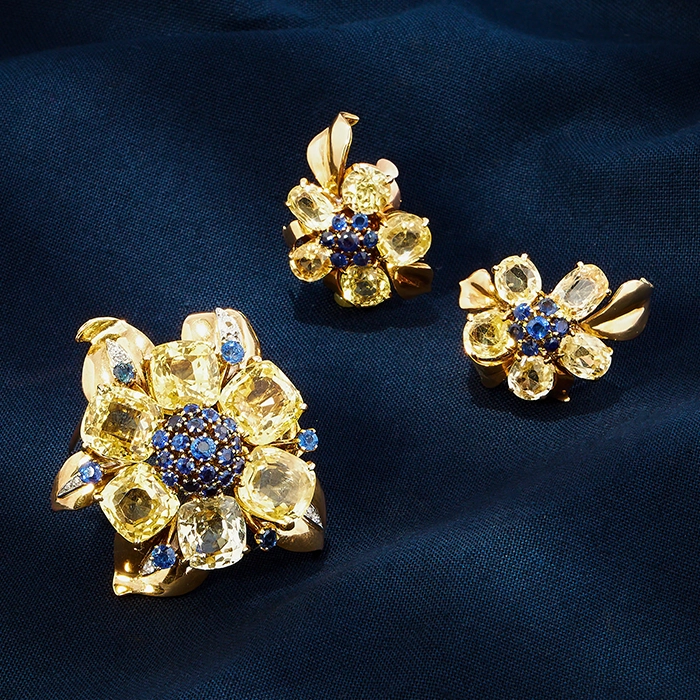
(Image: Van Cleef Arpel brooch and earrings from the estate of Ann Fleming.) |
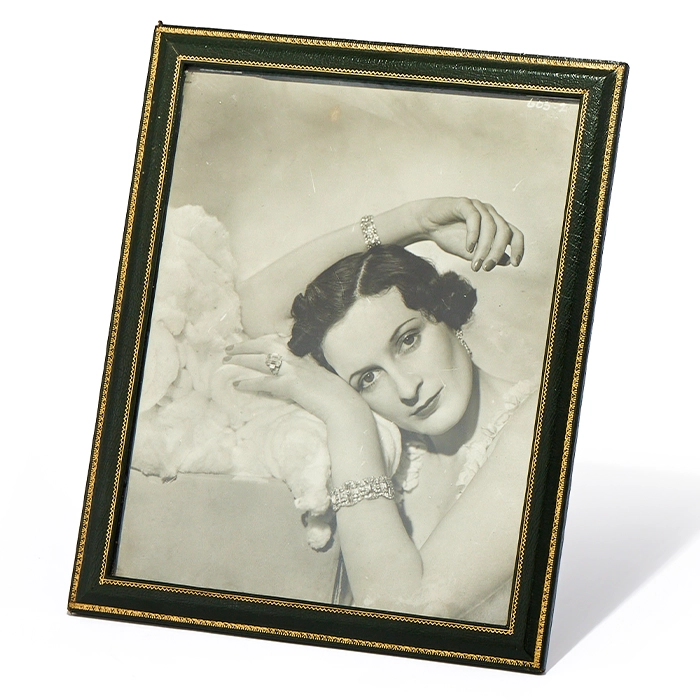
For instance, we recently sold a Van Cleef & Arpels brooch and earrings from the estate of Ann Fleming which had probably been worn to some incredible soirees! When Ann married her third husband author, Ian Fleming, she would often go to his retreat, Goldeneye, in Jamaica. While Fleming preferred quiet evenings Ann was very outgoing and entertained artists, socialites and writers including Evelyn Waugh and Noël Coward. The Van Cleef & Arpels blue sapphire, yellow sapphire and diamond set sold for £40,320 (inc. fees) against an estimate of £15,000 to £20,000 because we had the provenance. It dates to 1938, making it one of the earliest examples of the Passe Partout jewellery which captures the period when the art deco moved away from diamonds and platinum towards the softer 1940s’ styling with a warm hue of gold and almost cushion-shaped sapphires. The other beauty of this brooch is a fitting at the back so it could be worn as a clasp. Nowadays people don't often wear brooches but if they could wear it on a necklace without having to do any major work it gives a second functionality. The jewellery was originally bought at Van Cleef & Arpels in Paris by Ann’s first husband Lord O'Neill of Shanes Castle, in 1938 while she was having an affair with Esmond Harmsworth (not yet Lord Rothermere), who would become her second husband. When Ann heard that Lord O’Neill was going to Paris for a weekend with Guinness heiress Maureen, Marchioness of Dufferin and Ava, Ann insisted on going along. She decided to bring Harmsworth, and they were joined by Nancy and John Hare (later Lord Blakenham). During the weekend Lord O’Neill bought the jewels for Ann, and Nancy Hare wrote a poem called A Weekend in Paris in which Ann is lightly disguised as Jane. The final couplet goes: |
|
(Image: Portrait of Ann Fleming) |
Eltham Palace Cartier Jewels
While millionaires Sir Stephen and Lady Virginia were building Eltham Palace, in south-east London, Sir Stephen commissioned jeweller Cartier to design two jewels in the form of earrings which he presented to Virginia to mark the completion of their new home. Sir Stephen was part of the Courtauld textile empire and Virginia the daughter of a wealthy shipping merchant, and they created an Art Deco palace adjoining a medieval Great Hall that was built by King Edward IV. The property is now run by English Heritage.
Cartier used the stained-glass window designs in the restored Great Hall, by George Kruger Gray, for the diamond-encrusted brooches’ pattern in the form of King Edward IV cyphers; a white Tudor rose upon the starburst of Richard II, known as Rose en Soleil, and the Falcon and Fetterlock.
|
(Image: Cartier brooches) |
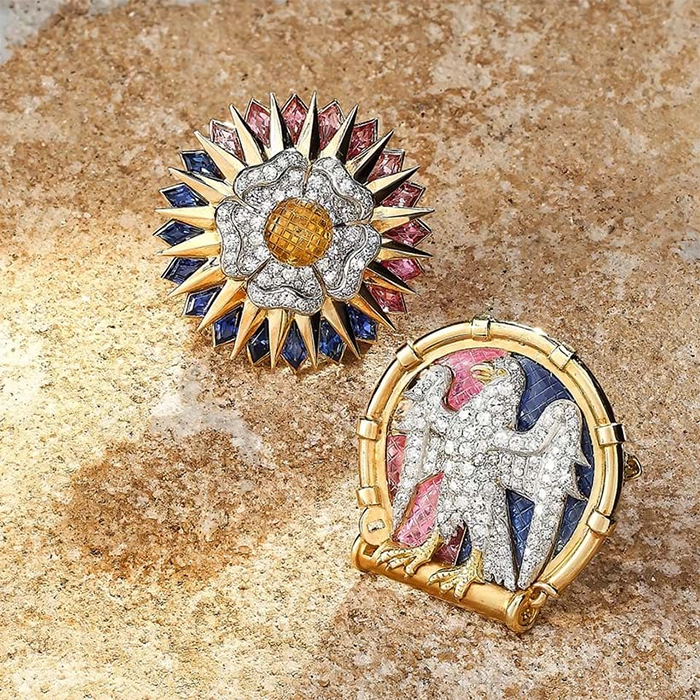
The brooches are now on display at Eltham Palace. When a charitable organisation such as English Heritage is looking to buy something at a sale, I find myself rooting for them because, in this case, the jewels would be preserved and go back to their home where they will be appreciated. The brooches sold for £23,940 (inc. fees) against an estimate £15,000-20,000.
As no surviving receipts have been discovered, it is unknown how much Stephen paid for these unique creations but the use of precious stones including diamonds, pink tourmaline, sapphire and citrine, alongside the Cartier name, means we can assume the commission would have been a considerable sum.
(english-heritage.org.uk)
20th century glitterati
Recently, we also auctioned pieces from the family collection of Syrie Maugham, who redefined interior design in the 20th century. The jewellery had been passed down the family and mainly belonged to Somerset (Willie) and Syrie Maugham’s daughter Liza and granddaughter Camilla. Syrie and Willie Maugham’s successful careers meant Liza grew up surrounded by the glitterati of the day such as playwright Noël Coward, photographer Cecil Beaton and stage designer Oliver Messel.
A Jean Schlumberger cultured pearl and diamond bracelet from the 1950s sold for £24,130 (inc. fees) against an estimate £10,000 – £15,0000). The provenance was two-fold – not only did the link to the Maugham family bring plenty of interest but so did the bracelet’s celebrated French jewellery designer Schlumberger. In the 1950s, Schlumberger was asked by Walter Hoving, Chairman of Tiffany & Co, to join the company as Vice President. Schlumberger went on to create some of the most incredible jewellery designs of the 20th century.
|
(Image: Cultured pearl and diamond bracelet by French jewellery designer Jean Schlumberger) |

Stunning emeralds
American art collector and philanthropist Irene Rothschild Guggenheim presented a stunning emerald and diamond bracelet to her daughter Eleanor May upon her marriage to Arthur Stuart, 7th Earl Castle Stuart in 1920. It sold at Dreweatts for £44,450 (inc. fees), more than five times the estimate of £4,000 – £6,000, and I am sure that the provenance added significantly to the final price, as did the juicy green emeralds! The bracelet featured three cabochon emeralds set between old European cut diamonds, connected by smaller emeralds to create a perfect blend of elegance and history.
|
(Image: Irene Rothschild Guggenheim presented this Van Cleef Arpels emerald and diamond bracelet to her daughter Eleanor May) |

Try before you buy
If you are thinking of buying vintage jewellery, I recommend buyers always look at jewellery in person because there is no substitute for seeing a jewel sparkle, feeling how a necklace lies around your neck or how earrings sit on your ear. The jewellery needs to feel comfortable so the wearer can truly enjoy it.
At Dreweatts we organise a host of previews with two days in London and three days in Newbury, Berkshire to give people the chance to try on jewellery. It is always best to pick up a piece of jewellery to feel the weight and get a sense of what it looks like with your own eyes.
Dreweatts’ next Fine Jewellery auction is on March 18, 2025. Visit dreweatts.com
About Charlotte Peel
Charlotte joined Dreweatts in February 2024 as Head of Jewellery. She has 20 years’ experience in the jewellery and fine art industry.
Having studied History of Art at Christie’s Education and UCL in London, she graduated with a Masters from the Courtauld Institute of Art in 2004. While working for an international private art collection in Geneva, she discovered her passion for jewellery and decided to retrain, gaining her Graduated Gemologist degree at GIA, New York in 2010.
Over the past 15 years Charlotte has worked as a jewellery specialist and head of department for some of the leading national and international auction houses in London.
Charlotte is passionate about jewellery and gemstones and enjoys giving talks and lectures on wide ranging topics from antique jewellery to contemporary designers and gemstone masterclasses.
|
|
Jewellery ValuationsWhether you are a long-term collector or new to buying jewellery, remember the importance of regular valuations. Professional jewellery valuations are vital, especially as market rates for precious metals and stones fluctuate quickly. Insurers recommend that you obtain a jewellery valuation at least every five years, preferably three in today’s market. But check your schedule and policy wording for specific requirements. A valuation not only prevents underinsurance but it’s evidence to support claim, and in our experience a claim is often settled much more quickly when there is an up-to-date valuation. A good valuation will include a description, weight, size and a photograph, the date and the valuer’s name and credentials. It’s a good idea to send a copy of your valuations to your broker, whether or not the insurer requires it. Insurers will require any valuation to be for “insurance purposes” and for retail value. You should also consider how you would replace your jewellery in the event of a loss. Would you want a brand new replacement with a modern equivalent (New Replacement Value), second hand replacement value (which can be more than the retail value if there’s a waiting list for a piece) or would you prefer an antique replacement (Antique Replacement Value)? We have taken the time to build relationships with valuation specialists and can point you in the direction here. |
Jewellery Insurance
When it comes to insuring high-value items like jewellery, being specific matters. Many policyholders assume their valuables are covered, but without specifying key items you could be left out of pocket in the event of a claim. You can read more about this is our article: Protecting your valuables: why it pays to be specific
Our people are not only experienced, but they’re also professionally qualified insurance advisers who understand the fine detail. We’ll take the time to review your policy wording to ensure it reflects your lifestyle, assets, and expectations. And in the event of a claim, our specialist Private Client claims team is here to support you - guiding you through the process and helping to secure the best possible outcome.
To speak to us about your insurance call 020 8256 4901 or email privateclients@howdeninsurance.co.uk